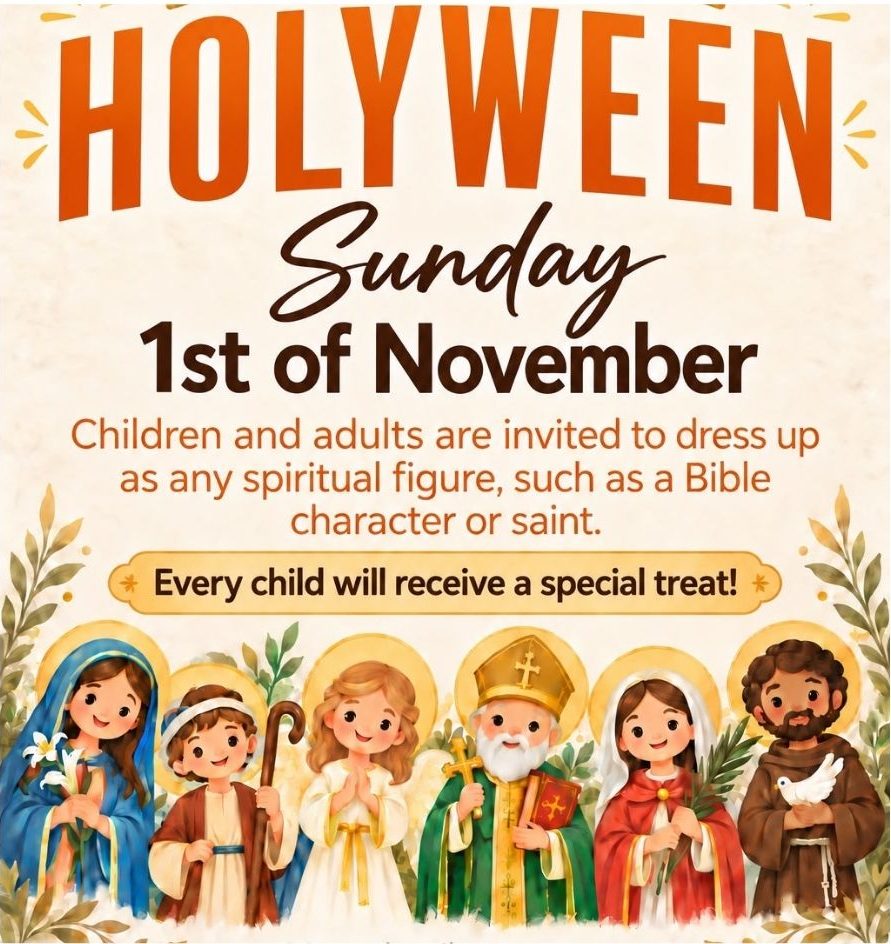
This Holyween, families are invited to celebrate the lives of inspiring figures from our faith by dressing up as a Bible character or saint.
Will you build an ark for your family? Is there a budding St Philomena among you? Embrace the day and take the opportunity to teach your children about the saints they dress up in. Parents are also invited to dress up if they choose to.
During Sunday School, each child will have the opportunity to share who they have dressed up as and tell us a little about their chosen character or saint.
It will be a wonderful opportunity for our children to learn about the faithful men and women who have followed God and to celebrate their examples of courage, love, service and devotion.
Each child will also receive a special treat during Sunday School as we celebrate together!
Sunday 1 NovemberHolyween SundayCome dressed as a Bible character or saint. Every child receives a special treat.
Praying on Sunday
Fr Luke and Fr Jonathan
This week at St John's
Tue
Kids Soccer, 4:30pm
Wed
Early Liturgy, 5 to 7am
Thu
Morning Liturgy, 8:30 to 10am Mothers Meeting, every second Thursday Kids Karate (ages 4+), 6 to 7:30pm English Classes, 6:30 to 7:30pm Tasbeha, 6:30pm
Friday 30 October
Prayer night for anyone wishing to lift up a prayer to God, 8pm
Sun
Divine Liturgy, 8:30am Kids Liturgy, 8:30am (ages 5+ only) The Way: coffee and a chat to delve deeper into our faith, 11 to 11:45am
Today's Gospel presents us with an incredible miracle. Jesus heals a man who is possessed by a demon, blind and mute. The humble masses are amazed and ask, "Could this be the Son of David?"
"Son of David" is a Messianic title, reserved for the promised Messiah, the King who would reign forever on the throne of David. The people were remembering the prophecy in Isaiah:
"Then the eyes of the blind shall be opened, and the ears of the deaf shall be unstopped. Then the lame shall leap like a deer, and the tongue of the dumb sing." (Isaiah 35:5–6)
They witnessed the miracle and began to recognise Jesus as the promised Saviour.
But standing opposite the masses were the Pharisees. They saw exactly the same miracle, yet reached the complete opposite conclusion. They said that Jesus "casts out demons by Beelzebub, the ruler of the demons."
How can two groups of people witness the same miracle, know the same prophecies and have access to the same facts, yet reach completely different conclusions about who Jesus is?
The answer becomes clearer when we consider the society in which Jesus lived.
There were broadly three groups in first-century Jerusalem: the elite, the middle tier and the masses.
The elite, perhaps the top 1–5%, included the High Priests, Sadducees, Herodian royalty and wealthy landowners. They were highly educated, wealthy and powerful. They controlled Temple wealth, taxation and political administration and, with Rome's backing, lived largely untouched by the struggles of ordinary people.
The middle tier, perhaps 5–10% of the population, included the Pharisees, scribes and prosperous merchants. They were educated, respected and relatively wealthy. They were religious teachers and business owners, and they were respected and feared by the masses.
Then there were the masses, making up the overwhelming majority of society. They were peasants, urban workers, day labourers, craftsmen, farmers, the poor, the sick and the destitute. Their lives were focused on daily survival. Heavy taxation, Roman oppression, sickness and poverty meant that every day brought uncertainty.
When we compare these groups, we begin to understand why they saw Jesus so differently.
The elite and middle tier had money, education, influence and security. They did not fear hunger or poverty. They could buy what they needed and, in many circumstances, use their wealth and influence to solve their problems.
But they also possessed the raw material for one of the most dangerous sins: pride.
They could look at themselves and think, I am intelligent. I am successful. I am powerful. I am respected. I do not need anyone.
And when we begin to believe that we are self-sufficient, we can begin to believe that we do not need God.
Pride drives away the grace of God. It makes us resemble the devil, the father of pride. And when we become like him, we begin to draw towards ourselves what we resemble.
This helps explain how the Pharisees could witness the same miracles as everyone else and yet see Jesus as the enemy. Their hearts had become darkened by pride.
Now consider the masses.
Their lives were completely different.
They lived day by day. Their income was often just enough to survive. Heavy taxation and Roman oppression meant that they constantly faced the possibility of hunger, sickness and poverty.
They were dependent on others for work and vulnerable to the decisions of those above them.
They had very little to be proud of.
And strangely, this became their greatest spiritual advantage.
Their poverty and uncertainty made them dependent on God.
They knew they needed Him.
Their circumstances created the raw material for humility.
And humility, the queen of the virtues, makes a person like God. Their humble hearts allowed the grace of God to open their eyes so that they could recognise Jesus for who He truly was.
So we have to ask ourselves a very uncomfortable question.
If we took our current position in Australia and transported ourselves back to the time of Jesus, which group would we belong to?
If we own a home, have a mortgage, own a car and live comfortably, we are already among a very privileged portion of the world's population. Add a university education, a successful business or significant financial security, and our position becomes even more privileged.
This should concern us.
Because it means we possess much of the same raw material for pride that existed among the elite and middle tier in the time of Jesus.
We have homes. We have money. We have cars. We have jobs. We have insurance, savings and investments. We can buy what we want, when we want.
Without even realising it, we can build our lives in such a way that we trust ourselves, our own wisdom and our own resources rather than trusting God.
And Jesus gives us a serious warning:
"How hard it is for those who have riches to enter the kingdom of God!"
But thank God, my brothers and sisters, being privileged does not exclude us from salvation.
What it does mean is that we have to work harder to cultivate humility.
We must put our brothers and sisters first. We must use our finances to help those who are less privileged. We must remember that every gift we have comes from God and never think that we are better than anyone else.
We must turn to God every day in repentance and humility and develop a deep, almost unceasing gratitude for His blessings.
We should have a healthy reverence and fear that our position, if we are not careful, may actually lead us away from Him.
That is why quiet time with God every day is absolutely non-negotiable.
We need time away from the noise. Away from social media. Away from the distractions of everyday life.
We need time to thank God, repent, pray for those who are suffering and consider how we can draw closer to Him.
Because if we do not seek God, if we do not give Him the glory for our education, our jobs, our money and our status, we can become people who simply attend Church and call ourselves Coptic Orthodox, without actually knowing Christ.
And when Jesus returns, we may discover that our hearts do not recognise Him or desire Him.
Jesus gives us a frightening warning:
"Many will say to Me in that day, 'Lord, Lord, have we not prophesied in Your name… and done many wonders in Your name?' And then I will declare to them, 'I never knew you; depart from Me, you who practice lawlessness!'"
Our goal cannot simply be to attend Church, have confession and Holy Communion, or serve in Sunday School.
Our goal must be to know Jesus.
A challenge for the week
So I want to give everyone a challenge.
If you do not already have quality time with God every day, for the next week, set your alarm 15 minutes earlier and spend that time with our beautiful Jesus.
If Jesus endured scourging, the tearing of His flesh, a crown of thorns driven into His blessed head and nails driven through His hands and feet for us, surely we can sacrifice 15 minutes of sleep in exchange for what He endured for us.
Use those 15 minutes in three simple ways.
First, spend five minutes talking to God. Thank Him for your blessings. Thank Him for your husband or wife, your children, your home, your food, clean water, your job and your car. Thank Him that you have been blessed to be a Christian. Thank Him for dying on the Cross for your sins and enduring suffering and torment to deliver you from eternal death.
Second, spend five minutes in repentance and prayer. Bring to mind the mistakes you have made and ask our beautiful Jesus for forgiveness. Ask Him to help you do better today. Then pray for your family, your friends, your neighbours and all of humanity, especially those who are sick and suffering.
Third, spend five minutes reading the Bible. Start with the Gospel of St Mark. It is short and accessible. Read one chapter slowly and pray that God will help you understand His Word.
Then, if you have time remaining, sit quietly.
Close your eyes and direct your mind and heart as though you are sitting at the foot of the Cross, looking up at Jesus.
Use a timer if you need to. Five minutes of prayer. Five minutes of Scripture. Five minutes of silence. Do it for one week.
I assure you, life will never be the same. You will begin to know Jesus on a deeper level.
My brothers and sisters, may God help us to seek Jesus daily and to humble ourselves daily.
We are incredibly privileged to have the blessings God has given us. But if we do not learn to be grateful and humble ourselves, the Lord may have to step in and humble us Himself.
We have only one goal in this life:
To know Jesus, to love Him and to love one another. Everything else is secondary.
Let us seek to have a heart like the humble masses: a heart that desires God, depends completely upon Him and seeks Him above everything else.
Because if our hearts are humble, when Jesus returns, we will recognise Him. And He will welcome us with open arms. Glory be to God forever.
Saints of St John's
St Samuel the Confessor
Feast day: 8 Kiahk · 17 December
Who was he? St Samuel the Confessor was an Egyptian monk and abbot who suffered greatly for refusing to abandon the Orthodox faith. He endured beating, exile and captivity, yet continued to pray, teach, forgive and care for others.
What can our family learn from St Samuel the Confessor?
1. Stand firm without becoming cruel
St Samuel suffered severe violence because he would not accept teaching he believed betrayed the faith of the Church. He refused to surrender his convictions, even when standing firm cost him comfort, safety and eventually the sight of one eye.
What it means for our family: Families need convictions, but firmness is not the same as aggression. We can say "This is what we believe" or "This is not right" without insulting, mocking or hating the person who disagrees with us.
Family challenge: Practise one respectful sentence for disagreement: "I don't agree, but I want to speak kindly." Use it when a real disagreement comes.
2. Do good even to someone who has hurt you
During captivity, the man who controlled St Samuel treated him harshly and tried to pressure him away from his faith. Later, when that man's son became gravely ill, St Samuel prayed for the boy and he recovered. Samuel responded to mistreatment with mercy rather than revenge.
What it means for our family: Our natural reaction is often: "Why should I help them after what they did?" St Samuel shows the strange freedom of Christian love. Mercy does not pretend harm was acceptable; it refuses to let another person's wrong decide who we become.
Family challenge: Think of someone who has annoyed or hurt you. Without excusing what happened, pray one sincere blessing for them.
3. Hard seasons can still produce good fruit
St Samuel's life included exile, displacement, captivity and repeated setbacks. Yet he continued teaching, formed a monastic community and strengthened many people in faith. The difficult chapters did not cancel his calling.
What it means for our family: Families sometimes enter seasons that do not look like the plan: moving, illness, financial pressure, friendship changes or disappointment. We can ask not only, "How do we get out of this?" but also, "What can God grow in us here?"
Family challenge: Name one hard thing your family is facing and choose one virtue to practise because of it: patience, generosity, courage, prayer or gratitude.
Source: Nayrouz Saint Packs
Building
Sneak preview of our new church building
If you have been wondering about how the new church build is progressing, Fr Luke kindly shared a preview in our St John's Family chat this week. The pictures below illustrate the master plan to accommodate our growing community.
Kids Underground Church. The existing soccer court will be preserved, and the area will be extended to accommodate a Kids Church.New Sunday School rooms and a new mothers room at the front of the hall, where the stage was.We're also upgrading the existing soccer court with new flooring, rendered walls and improved lighting.We will place all our families' names under the altar foundation as an everlasting testimonial. You are also invited to place prayer requests from you or your children in a box at the back of the church, to be placed under the altar.
We're also adding a new library on the mezzanine level, above the former stage area and overlooking the main hall.
If you are willing and able to contribute, we warmly invite you to do so through the donations page on our church app, or by giving to the Building Fund. A huge investment is being made in us and our children. Fr Luke has stressed that if you can't donate, your prayers will also help grow and establish our church. Your love, prayers and heartfelt desire to give are just as precious in the eyes of God.